Cloth $85.00 ISBN: 9780226494036 Published October 2012
Paper $27.50 ISBN: 9780226494043 Published October 2012
E-book $7.00 to $27.50 About E-books ISBN: 9780226494050 Published August 2012

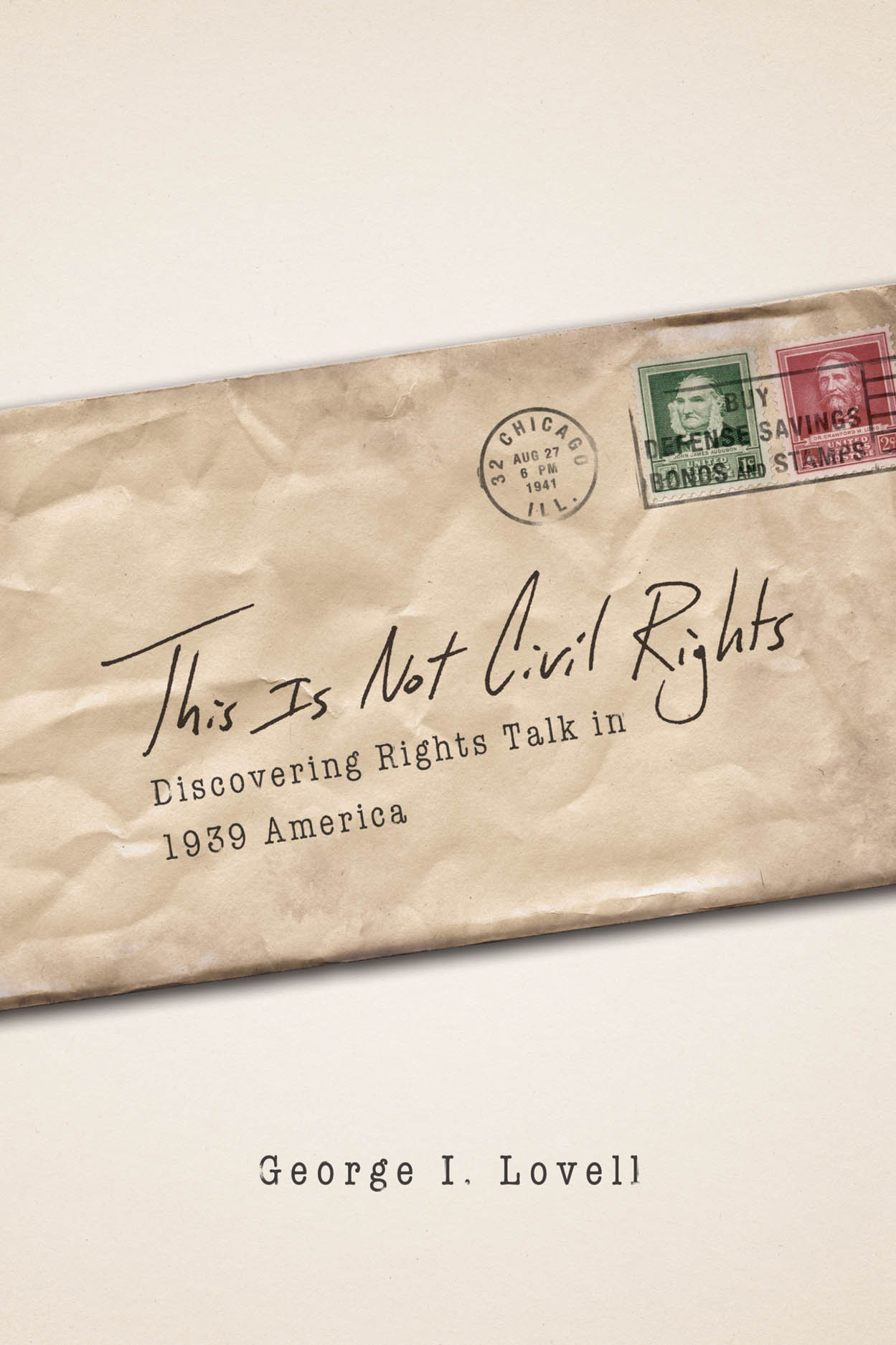
This Is Not Civil Rights

Discovering Rights Talk in 1939 America

George I. Lovell

George I. Lovell

280 pages | 1 halftone | 6 x 9 | © 2012
Cloth $85.00 ISBN: 9780226494036 Published October 2012
Paper $27.50 ISBN: 9780226494043 Published October 2012
E-book $7.00 to $27.50 About E-books ISBN: 9780226494050 Published August 2012

Since at least the time of Tocqueville, observers have noted that Americans draw on the language of rights when expressing dissatisfaction with political and social conditions. As the United States confronts a complicated set of twenty-first-century problems, that tradition continues, with Americans invoking symbolic events of the founding era to frame calls for change. Most observers have been critical of such “rights talk.” Scholars on the left worry that it limits the range of political demands to those that can be articulated as legally recognized rights, while conservatives fear that it creates unrealistic expectations of entitlement.
 
Drawing on a remarkable cache of Depression-era complaint letters written by ordinary Americans to the Justice Department, George I. Lovell challenges these common claims. Although the letters were written prior to the emergence of the modern civil rights movement—which most people assume is the origin of rights talk—many contain novel legal arguments, including expansive demands for new entitlements that went beyond what authorities had regarded as legitimate or required by law. Lovell demonstrates that rights talk is more malleable and less constraining than is generally believed. Americans, he shows, are capable of deploying idealized legal claims as a rhetorical tool for expressing their aspirations for a more just society while retaining a realistic understanding that the law often falls short of its own ideals.

Charles R. Epp, University of Kansas

“A masterly and potentially pathbreaking analysis of American ‘rights talk,’ a much-maligned but largely misunderstood phenomenon. Using a trove of letters written in 1939 and 1940 by ordinary Americans to the Justice Department’s then-new Civil Liberties Unit, George I. Lovell shows that many of the standard claims about American rights talk are wrong; beyond the fervent hope for a rights-regulated society lies a worldly wise realism about rights’ limited capacity to bring about real change.”

Keith J. Bybee, Syracuse University

“With This Is Not Civil Rights, George I. Lovell makes an invaluable contribution to the study of ‘rights talk’ and legal consciousness in the United States. His arguments will compel scholars to rethink the relationship between ordinary people, government power, and the emancipatory potential of law.”
Mark Graber, University of Maryland
“George I. Lovell has written a fascinating, important, and page-turning account of how ordinary people in American history have insisted that government take into account and respond to their vision of what constitutes fundamental rights. This is both an instant classic in law and society and a vital resource for proponents of popular constitutionalism.”
Harvard Law Review
“In This Is Not Civil Rights, George I. Lovell uses a historical case study to challenge conventional understandings of rights-based discourse. Focusing on the period between 1939 and 1941, Lovell examines complaint letters from citizens to the Department of Justice’s Civil Rights Section. Although the letters cover everything from vehicle-licensing requirements for seasonal lettuce pickers to police brutality against African Americans, many writers framed their grievances in terms of civil rights and constitutional protections. After analyzing the letters and the Civil Rights Section’s responses, Lovell concludes that the writers were able to use rights-based language without losing sight of the fact that law did not live up to its expressed ideals and without succumbing to official law’s claim to set some objective or universal standard for justice or legitimacy. . . . This optimistic new view is sure to stimulate debate about the future role of rights-based discourse.”
Law and Politics Book Review
This Is Not Civil Rights challenges much of the conventional wisdom surrounding citizens’ use of ‘rights talk’ in the United States, making a compelling case for the need for greater research in how typical Americans use the language of rights to push for societal and governmental change. . . . George I. Lovell carefully analyzes the claims documented in a cache of letters found buried in the National Archives, written to the Roosevelt administration during the transition from the Great Depression to World War II. . . . His examination of the legal and rights language used by average citizens, who are frequently perceived to be apolitical, provides a more sophisticated understanding of the position the law plays in the lives of Americans.”
Choice
"This is Not Civil Rights examines letters written by Americans in 1939 to the newly created Civil Rights Section (CRS) of the US Department of Justice. George I. Lovell finds value in these letters as informative about how citizens and the government think about rights and as indicative of a gap between the formal law and what people think the law is. A good addition to collections on American law and civil rights."
Contents
Preface
Acknowledgments

Chapter 1. Voices from Peoria
Chapter 2. The CRS’s Legal and Political Strategies for Improving Civil Rights Protections
Chapter 3. Dead Dogs, Bad Divorces, and, Dope-Peddling Sheriffs: The Subject Matter of Civil Rights Complaint Letters
Chapter 4. The Common Place of Lawyering: Using Legal and Constitutional Arguments to Support Novel Civil Rights Claims
Chapter 5. Underlying Commitments of Rights Claiming: Extralegal Persuasive Claims and Citizen Understandings of Law
Chapter 6. In Defense of Extravagant Rights Talk

Appendix: Notes on the Archival Sources

Notes
Bibliography
Index
For more information, or to order this book, please visit http://www.press.uchicago.edu
Google preview here

Chicago Manual of Style |

Events in Law

Keep Informed

JOURNALs in Law