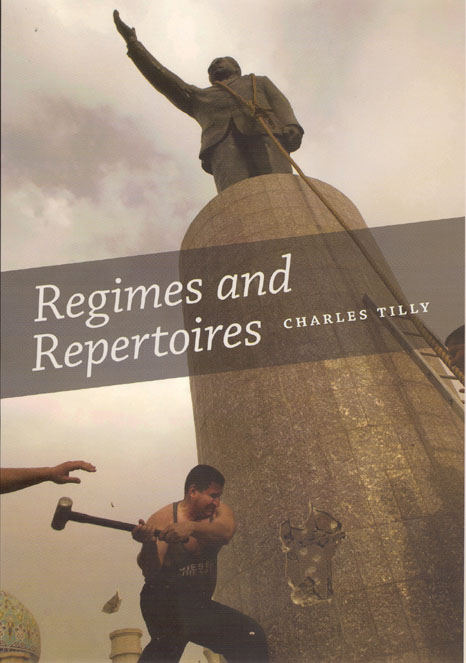
Cloth $37.50 ISBN: 9780226803500 Published September 2006
E-book $7.00 to $30.00 About E-books ISBN: 9780226803531 Published February 2010

Regimes and Repertoires

Charles Tilly

 Regimes and Repertoires
Bookmark and Share

Charles Tilly

240 pages | 18 line drawings, 11 tables | 6 x 9 | © 2006
Cloth $37.50 ISBN: 9780226803500 Published September 2006
E-book $7.00 to $30.00 About E-books ISBN: 9780226803531 Published February 2010

The means by which people protest—that is, their repertoires of contention—vary radically from one political regime to the next. Highly capable undemocratic regimes such as China's show no visible signs of popular social movements, yet produce many citizen protests against arbitrary, predatory government. Less effective and undemocratic governments like the Sudan’s, meanwhile, often experience regional insurgencies and even civil wars. In Regimes and Repertoires, Charles Tilly offers a fascinating and wide-ranging case-by-case study of various types of government and the equally various styles of protests they foster.

Using examples drawn from many areas—G8 summit and anti-globalization protests, Hindu activism in 1980s India, nineteenth-century English Chartists organizing on behalf of workers' rights, the revolutions of 1848, and civil wars in Angola, Chechnya, and Kosovo—Tilly masterfully shows that such episodes of contentious politics unfold like loosely scripted theater. Along the way, Tilly also brings forth powerful tools to sort out the reasons why certain political regimes vary and change, how the people living under them make claims on their government, and what connections can be drawn between regime change and the character of contentious politics.

Social Science Research Council: Albert O. Hirschman Prize
Won

View Recent Awards page for more award winning books.

“In Regimes and Repertoires, Charles Tilly is at his inventive and wide-ranging best. Tilly takes us into the minds of rulers and rebels to examine how their opportunities and choices have shaped each others’ actions. Using a simple but powerful theory of regime types and a rich array of historical and contemporary cases, he provides fresh new explanations for the variation in modern political struggles, from peaceful protest to genocide and terrorism. This small book bursts with big ideas.”--Jack Goldstone, George Mason University


“Anyone opening a new book by Charles Tilly brings a lot of expectations to the text, and this book lives up to them. Tilly argues that broad differences among political regimes tend to produce broad differences in patterns of contention. The big abstract arguments are elaborated by way of a myriad of concrete instances, and there are exciting and challenging insights on practically every page. This is another winner by an author who has given us many.”--John Markoff, University of Pittsburgh


"This book is at once theoretically illuminating, historically conscious and comprehensively insightful. The work will be of interest to a broad audience including students of comparative politics, political change and international relations. . . . Students of state formation particularly will find the book very interesting."—Adham Saouli, Political Studies Review


"This book will be invaluable to any doctoral students or researchers interested in the contentious area of political and conceptual study."—Matt McCullock, H-Net Review


"In this fascinating book, Tilly analyzes the alternative patterns of interaction between regime types and repetoires, historically created claimsmaking performances that channel the struggles of people in contentious politics. He discusses how political regimes vary and change; how repertoires change; how variation and shifts in the nature of regimes and variation in contentious politics affect each other; and how the interaction between the two produce collective violence, civil wars, social movements, or revolutions. . . . This is an important, compelling work. It is immensely readable and captivating. It is a must for scholars interested in theories of the state, and popular contentious politics."—Misgah Parsa, Mobilization


Contents
Preface
1. What Are Regimes?
2. How Regimes Work
3. Repertoires of Contention
4. Repertoires, Meet Regimes
5. Trajectories of Change
6. Collective Violence
7. Revolutions
8. Social Movements
9. Conclusions
References
Index
For more information, or to order this book, please visit http://www.press.uchicago.edu
Google preview here

Chicago Manual of Style |

Chicago Blog: Politics and Current Events

Events in Politics and Current Events

Keep Informed

JOURNALs