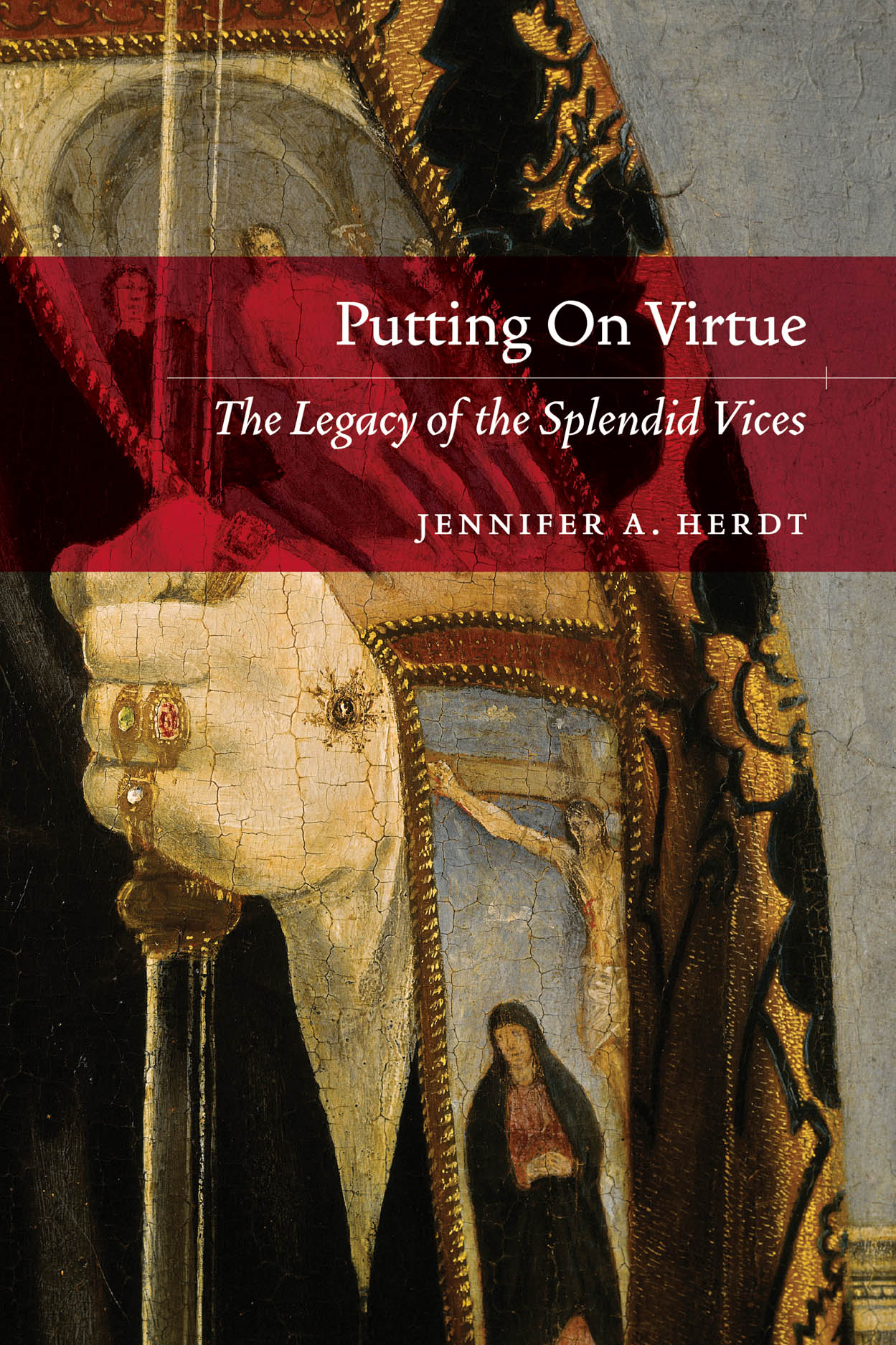
Cloth $55.00 ISBN: 9780226327242 Published November 2008
Paper $35.00 ISBN: 9780226327198 Will Publish May 2012
E-book $7.00 to $30.00 About E-books ISBN: 9780226327259 Published May 2009

Putting On Virtue

The Legacy of the Splendid Vices

Jennifer A. Herdt

 Putting On Virtue
Bookmark and Share

Jennifer A. Herdt

472 pages | 6 x 9 | © 2008
Cloth $55.00 ISBN: 9780226327242 Published November 2008
Paper $35.00 ISBN: 9780226327198 Will Publish May 2012
E-book $7.00 to $30.00 About E-books ISBN: 9780226327259 Published May 2009
Augustine famously claimed that the virtues of pagan Rome were nothing more than splendid vices. This critique reinvented itself as a suspicion of acquired virtue as such, and true Christian virtue has, ever since, been set against a false, hypocritical virtue alleged merely to conceal pride. Putting On Virtue reveals how a distrust of learned and habituated virtue shaped both early modern Christian moral reflection and secular forms of ethical thought. 
Jennifer Herdt develops her claims through an argument of broad historical sweep, which brings together the Aristotelian tradition as taken up by Thomas Aquinas with the early modern thinkers who shaped modern liberalism. In chapters on Luther, Bunyan, the Jansenists, Mandeville, Hume, Rousseau, and Kant, she argues that efforts to make a radical distinction between true Christian virtue and its tainted imitations actually created an autonomous natural ethics separate from Christianity. This secular value system valorized pride and authenticity, while rendering graced human agency less meaningful. Ultimately, Putting On Virtue traces a path from suspicion of virtue to its secular inversion, from confession of dependence to assertion of independence.

Choice Magazine: CHOICE Outstanding Academic Title Awards
Won

View Recent Awards page for more award winning books.

Putting On Virtue is one of the most important books on ethical formation to appear in a long time. Its account of early modern struggles over the ambiguous legacies of Aristotle and Augustine fills an enormous gap in the scholarly literature. But the book’s central question is of utmost contemporary urgency: Does either secular society or the church have sufficient understanding of ethical formation to be capable of transmitting the virtues to future generations? Herdt must now be recognized as one of the most learned and perceptive historians of ethics we have.”—Jeffrey Stout, professor of religion at Princeton University and author of Democracy and Tradition


“Jennifer Herdt offers in this volume a searching new case for both a Christian ethic of mimetic virtue and a generous assessment of pagan virtue. She examines major theological and philosophical figures, from Augustine to Kant, yet shows throughout how they inform contemporary reflection on virtue. Fresh retrievals appear, including the figure of Erasmus, who illustrates a ‘salutary holism’ of acquired and infused virtues that she herself extols.  Important texts and claims commingle, from an author who makes her formidable learning laudably accessible.”—Gene Outka, Yale University


“Can we become good by training ourselves to act in the way a good person would?  Can true virtue be developed apart from a community in which our dependence upon God is acknowledged? Can we ever reach a point in our moral development at which we may be confident that God’s judgment of our character must be favorable?  In a study that is historical in its development and normative in its aims, Jennifer Herdt probes such questions with precision and elegance.  Even readers not fully persuaded by her normative claims will be invited and challenged to think through fundamental questions of the moral life.”—Gilbert Meilaender, Valparaiso University


Putting On Virtue sets a new standard for work in Christian Ethics. Jennifer Herdt not only introduces significant historical material that has been ignored by those who have thought to reclaim virtue tradition, but, just as importantly provides fresh readings of Aristotle, Augustine, and Aquinas. I know of no higher praise I can give a book than to say I look forward to teaching it as soon as possible. What a remarkable achievement.”—Stanley Hauerwas, Duke University


“Jennifer Herdt’s book is, far and away, the best recent work in Christian ethics that we have.”—John R. Bowlin, Princeton Theological Seminary


"This first-rate work deserves wide reading, and should be added to most college and all theological libraries. By demonstrating a keen command of theological and philosophical issues, it easily finds a place among the finest works on theological ethics. Essential."—Choice


2009 Choice Outstanding Academic Title


"Erudite and lucid, Jennifer Herdt's comprehensive study of theological and secular virtue is exceptionally engaging . . . . A theologically rich, historically grounded, and philosophically challenging book. . . . that resembles the magisterial work of Charles Taylor."—Jonathan Rothchild, Journal of Theological Studies


"In terms of both breadth and depth, Herdt's book is a masterful treatise. Its originality and intrigue lie in two areas in particular. The first is her overall project of demonstrating how this tension of mimesis and performance lies at the heart of virtue-based morality. . . . The second area of originality is her specific retrieval of many thinkers who have often been overlooked in terms of what contribution they might make to contemporary discussions of virtue."—Tom Grimwood, Metapsychology


Contents
Preface
Introduction
 
Part I:  Splendid Vices and Imperfect Virtues
1          Aristotle and the Puzzles of Habituation
2          Augustine: Disordered Loves and the Problem of Pride
3          Aquinas: Making Space for Pagan Virtue
 
Part II: Mimetic Virtue
4          Erasmus: Putting On Christ
5          The Jesuit Theatrical Tradition: Acting Virtuous
 
Part III:  The Exodus from Virtue
6          Luther: Saved Hypocrites
7          Bunyan and Puritan Life-Writing: The Virtue of Self-Examination
 
Part IV: The Anatomy of Virtue
8          Jesuits and Jansenists: Gracián and Pascal
9          Emancipating Worldly Virtue: Nicole, La Rochefoucauld, and Mandeville
 
Part V: Pagan Virtue and Modern Moral Philosophy
10        Rousseau and the Virtue of Authenticity
11        Hume and the Bourgeois Rehabilitation of Pride
12        Kant and the Pursuit of Noumenal Purity
 
Conclusion
Notes
Index
For more information, or to order this book, please visit http://www.press.uchicago.edu
Google preview here

Chicago Manual of Style |

Chicago Blog: Religion

Events in Religion

Keep Informed

JOURNALs