The Pinocchio Effect
On Making Italians, 1860-1920
9780226774480
The Pinocchio Effect
On Making Italians, 1860-1920
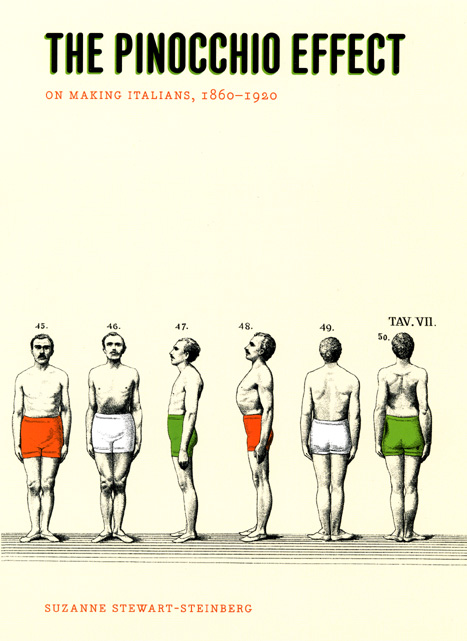
Soon after the disparate states of the Italian peninsula unified in the 1860s to create a single nation, the nationalist Massimo D’Azeglio is said to have remarked, “We have made Italy, now we have to make Italians.” The Pinocchio Effect draws on a remarkably broad array of sources to trace this making of a modern national identity in Italy, a subject that remains strikingly understudied in the English-speaking world of Italian studies.
Taking as her guiding metaphor the character of Pinocchio—a national icon made famous in 1881 by the eponymous children’s book—Susan Stewart-Steinberg argues that just like the renowned puppet, modern Italians were caught in a complex interplay between freely chosen submission and submission demanded by an outside force. In doing so, she explores all the ways that identity was constructed through newly formed attachments, voluntary and otherwise, to the young nation. Featuring deft readings of the period’s most important Italian cultural and social thinkers—including the theorist of mass psychology Scipio Sighele, the authors Matilde Serao and Edmondo De Amicis, the criminologist Cesare Lombroso, and the pedagogue Maria Montessori—Stewart-Steinberg’s richly multidisciplinary book will set a new standard in Italian studies.
Taking as her guiding metaphor the character of Pinocchio—a national icon made famous in 1881 by the eponymous children’s book—Susan Stewart-Steinberg argues that just like the renowned puppet, modern Italians were caught in a complex interplay between freely chosen submission and submission demanded by an outside force. In doing so, she explores all the ways that identity was constructed through newly formed attachments, voluntary and otherwise, to the young nation. Featuring deft readings of the period’s most important Italian cultural and social thinkers—including the theorist of mass psychology Scipio Sighele, the authors Matilde Serao and Edmondo De Amicis, the criminologist Cesare Lombroso, and the pedagogue Maria Montessori—Stewart-Steinberg’s richly multidisciplinary book will set a new standard in Italian studies.
400 pages | 74 halftones | 6 x 9 | © 2007
History: European History
Literature and Literary Criticism: Romance Languages
Reviews

Table of Contents
List of Illustrations
Acknowledgments
Introduction
1 The Pinocchio Effect: On Autonomy and Influence
2 The Secret Power of Suggestion: Scipio Sighele’s Succubal Subject
3 The Queen and the Deputy: The Representative Politics of Matilde Serao’s La Conquista di Roma
4 Love’s Gravity: The Perverse Gymnastics of Edmondo De Amicis
5 An Unwritable Law of Maternal Love: The Infanticide Debate
6 In a Dark Continent: Cesare Lombroso’s Other Italy
7 Social Maria: The Scientific Feminism of Maria Montessori
8 Maria Montessori: The Writing Subject
Conclusion
Notes
Works Cited
Index
Acknowledgments
Introduction
1 The Pinocchio Effect: On Autonomy and Influence
2 The Secret Power of Suggestion: Scipio Sighele’s Succubal Subject
3 The Queen and the Deputy: The Representative Politics of Matilde Serao’s La Conquista di Roma
4 Love’s Gravity: The Perverse Gymnastics of Edmondo De Amicis
5 An Unwritable Law of Maternal Love: The Infanticide Debate
6 In a Dark Continent: Cesare Lombroso’s Other Italy
7 Social Maria: The Scientific Feminism of Maria Montessori
8 Maria Montessori: The Writing Subject
Conclusion
Notes
Works Cited
Index
Awards
Modern Language Association: Aldo and Jeanne Scaglione Publication Award for a Manuscript in Italian Literary Studies
Won