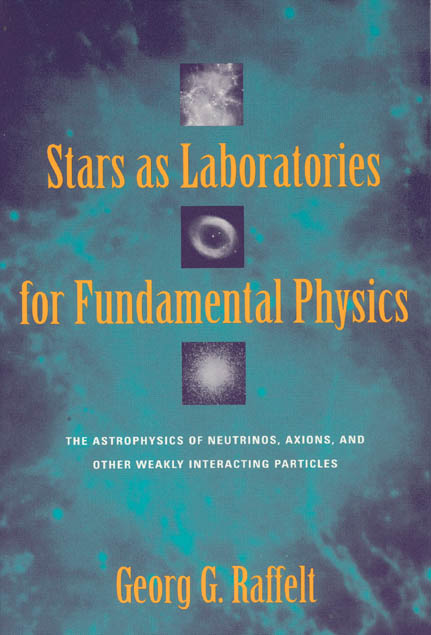
Stars as Laboratories for Fundamental Physics
The Astrophysics of Neutrinos, Axions, and Other Weakly Interacting Particles
9780226702728
Stars as Laboratories for Fundamental Physics
The Astrophysics of Neutrinos, Axions, and Other Weakly Interacting Particles
The first extended work of its kind, Stars as Laboratories for Fundamental Physics stands at the intersection of two burgeoning fields, astrophysics and particle physics. Georg Raffelt, one of the world’s leading researchers in this field, describes what the study of stars reveals about fundamental particle interactions.
Raffelt presents the many uses of stellar astrophysics for research in basic particle physics. He focuses primarily on the properties and nongravitational interactions of elementary particles. Numerous graphs and figures complement the text.
Stars as Laboratories for Fundamental Physics is a valuable reference for cosmologists, astrophysicists, and particle physicists.
Raffelt presents the many uses of stellar astrophysics for research in basic particle physics. He focuses primarily on the properties and nongravitational interactions of elementary particles. Numerous graphs and figures complement the text.
Stars as Laboratories for Fundamental Physics is a valuable reference for cosmologists, astrophysicists, and particle physicists.
686 pages | 188 line drawings, 34 tables | 6 x 9 | © 1996
Physical Sciences: Astronomy and Astrophysics, Physics and Astronomy

Table of Contents
Preface
Acknowledgments
1: The Energy-Loss Argument
2: Anomalous Stellar Energy Losses Bounded by Observations
3: Particles Interacting with Electrons and Baryons
4: Processes in a Nuclear Medium
5: Two-Photon Coupling of Low-Mass Bosons
6: Particle Dispersion and Decays in Media
7: Nonstandard Neutrinos
8: Neutrino Oscillations
9: Oscillations of Trapped Neutrinos
10: Solar Neutrinos
11: Supernova Neutrinos
12: Radiative Particle Decays from Distant Sources
13: What Have We Learned from SN 1987A?
14: Axions
15: Miscellaneous Exotica
16: Neutrinos: The Bottom Line
App. A. Units and Dimensions
App. B. Neutrino Coupling Constants
App. C. Numerical Neutrino Energy-Loss Rates
App. D. Characteristics of Stellar Plasmas
References
Acronyms
Symbols
Subject Index
Acknowledgments
1: The Energy-Loss Argument
2: Anomalous Stellar Energy Losses Bounded by Observations
3: Particles Interacting with Electrons and Baryons
4: Processes in a Nuclear Medium
5: Two-Photon Coupling of Low-Mass Bosons
6: Particle Dispersion and Decays in Media
7: Nonstandard Neutrinos
8: Neutrino Oscillations
9: Oscillations of Trapped Neutrinos
10: Solar Neutrinos
11: Supernova Neutrinos
12: Radiative Particle Decays from Distant Sources
13: What Have We Learned from SN 1987A?
14: Axions
15: Miscellaneous Exotica
16: Neutrinos: The Bottom Line
App. A. Units and Dimensions
App. B. Neutrino Coupling Constants
App. C. Numerical Neutrino Energy-Loss Rates
App. D. Characteristics of Stellar Plasmas
References
Acronyms
Symbols
Subject Index