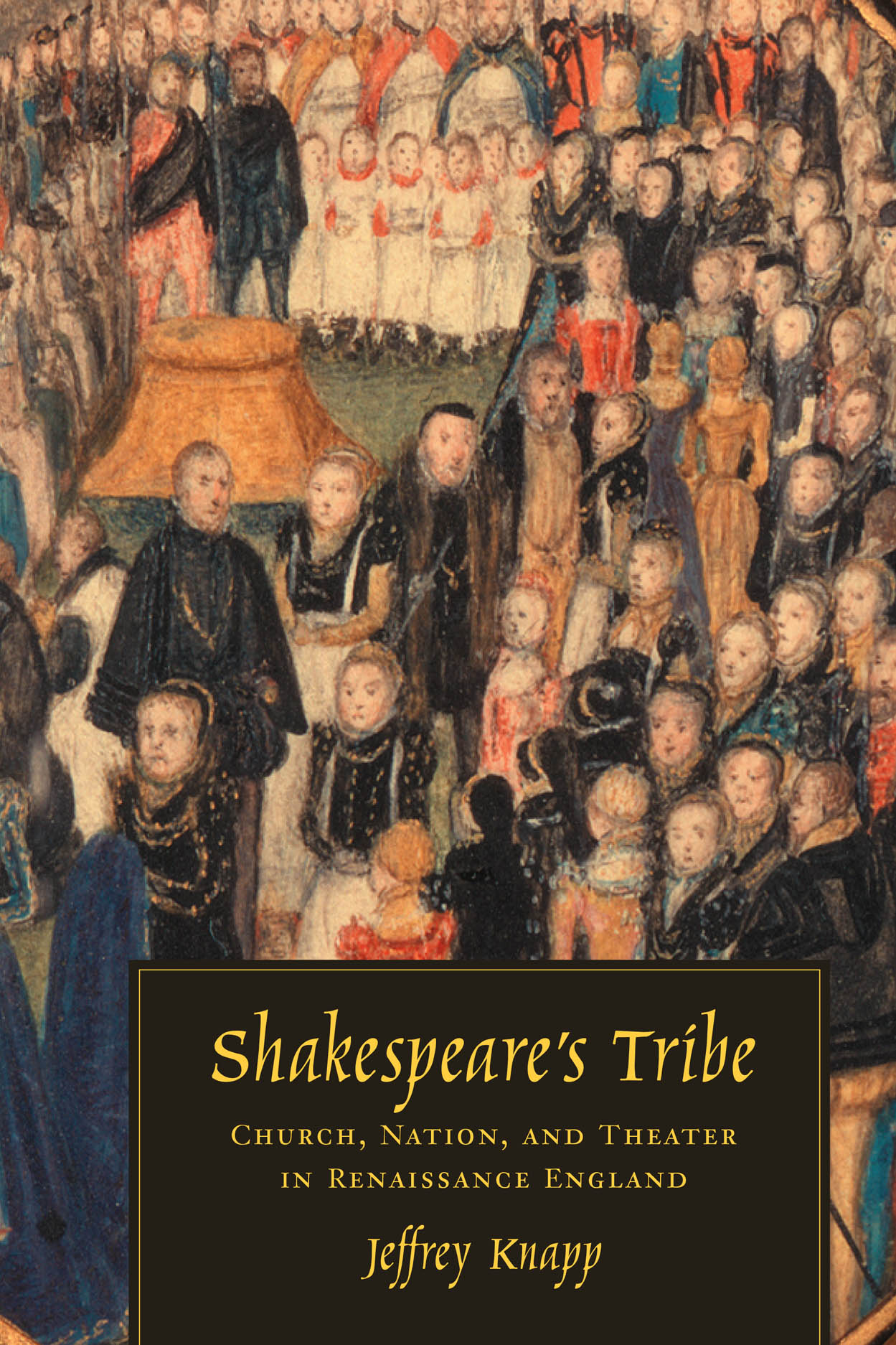
Shakespeare’s Tribe
Church, Nation, and Theater in Renaissance England
9780226445700
Shakespeare’s Tribe
Church, Nation, and Theater in Renaissance England
Most contemporary critics characterize Shakespeare and his tribe of fellow playwrights and players as resolutely secular, interested in religion only as a matter of politics or as a rival source of popular entertainment. Yet as Jeffrey Knapp demonstrates in this radical new reading, a surprising number of writers throughout the English Renaissance, including Shakespeare himself, represented plays as supporting the cause of true religion.
To be sure, Renaissance playwrights rarely sermonized in their plays, which seemed preoccupied with sex, violence, and crime. During a time when acting was regarded as a kind of vice, many theater professionals used their apparent godlessness to advantage, claiming that it enabled them to save wayward souls the church could not otherwise reach. The stage, they argued, made possible an ecumenical ministry, which would help transform Reformation England into a more inclusive Christian society.
Drawing on a variety of little-known as well as celebrated plays, along with a host of other documents from the English Renaissance, Shakespeare’s Tribe changes the way we think about Shakespeare and the culture that produced him.
Winner of the Best Book in Literature and Language from the Association of American Publishers’ Professional/Scholarly division, the Conference on Christianity and Literature Book Award, and the Roland H. Bainton Prize for Literature from the Sixteenth Century Society and Conference.
To be sure, Renaissance playwrights rarely sermonized in their plays, which seemed preoccupied with sex, violence, and crime. During a time when acting was regarded as a kind of vice, many theater professionals used their apparent godlessness to advantage, claiming that it enabled them to save wayward souls the church could not otherwise reach. The stage, they argued, made possible an ecumenical ministry, which would help transform Reformation England into a more inclusive Christian society.
Drawing on a variety of little-known as well as celebrated plays, along with a host of other documents from the English Renaissance, Shakespeare’s Tribe changes the way we think about Shakespeare and the culture that produced him.
Winner of the Best Book in Literature and Language from the Association of American Publishers’ Professional/Scholarly division, the Conference on Christianity and Literature Book Award, and the Roland H. Bainton Prize for Literature from the Sixteenth Century Society and Conference.

Table of Contents
List of Illustrations
Preface
Acknowledgments
Introduction
1. Good Fellows
Part One. England and Christendom
2. Rogue Nationalism
3. This Blessed Plot
Part Two. Church and Theater
4. Preachers and Players
5. Pseudo-Christianity
Epilogue
Appendix 1. Rogue Frequencies
Appendix 2. Autolycus
Appendix 3. Poetry as Cozenage
Notes
Works Cited
Index
Preface
Acknowledgments
Introduction
1. Good Fellows
Part One. England and Christendom
2. Rogue Nationalism
3. This Blessed Plot
Part Two. Church and Theater
4. Preachers and Players
5. Pseudo-Christianity
Epilogue
Appendix 1. Rogue Frequencies
Appendix 2. Autolycus
Appendix 3. Poetry as Cozenage
Notes
Works Cited
Index
Awards
Conference on Christianity and Lit.: Conference on Christianity and Literature Book Award
Won
Association of American Publishers: PROSE Book Award
Won
Sixteenth Century Studies Conference: Roland H. Bainton Book Prize
Won