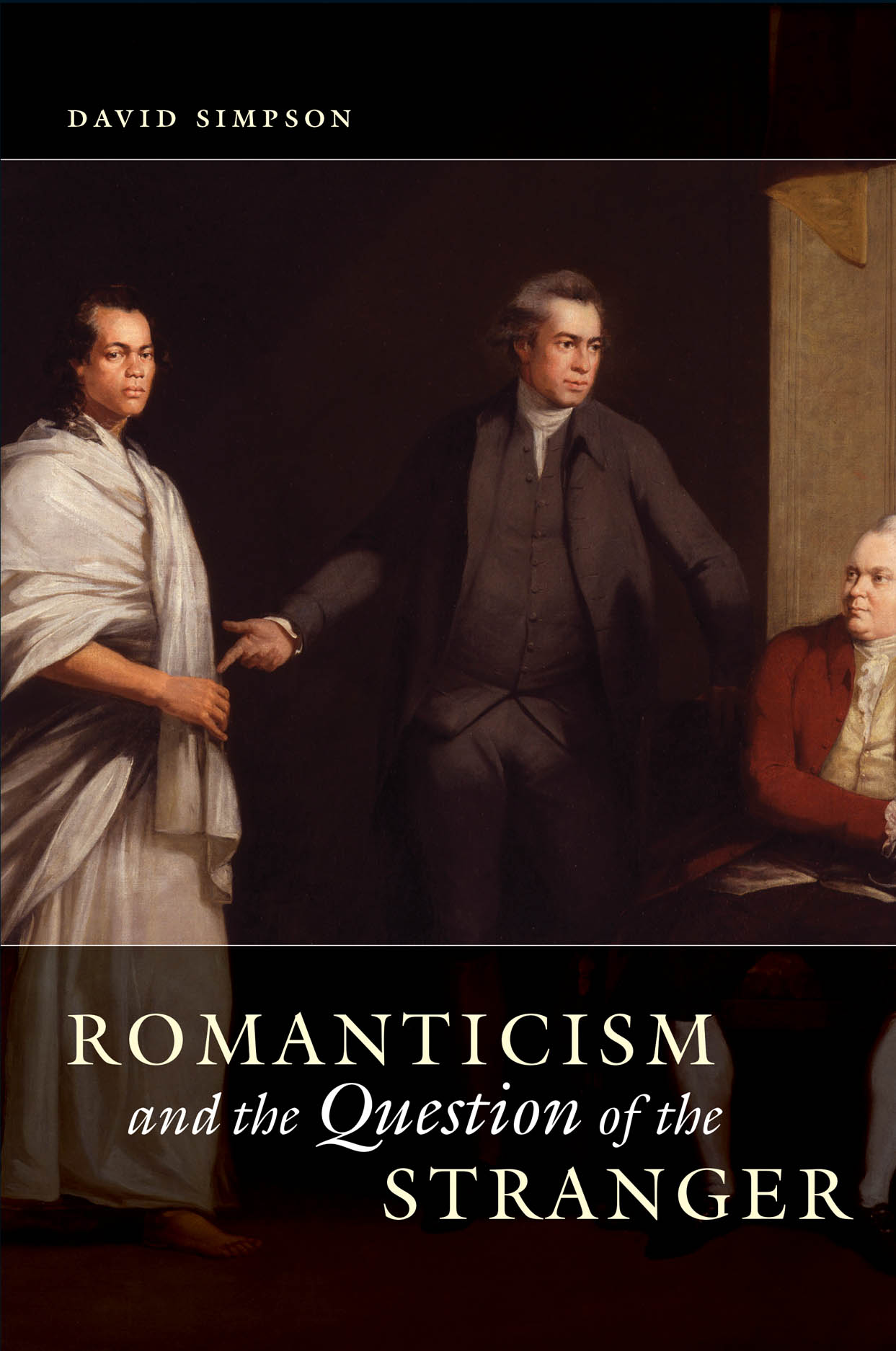
Romanticism and the Question of the Stranger
9780226922355
9780226922362
Romanticism and the Question of the Stranger
In our post-9/11 world, the figure of the stranger—the foreigner, the enemy, the unknown visitor—carries a particular urgency, and the force of language used to describe those who are “different” has become particularly strong. But arguments about the stranger are not unique to our time. In Romanticism and the Question of the Stranger, David Simpson locates the figure of the stranger and the rhetoric of strangeness in romanticism and places them in a tradition that extends from antiquity to today.
Simpson shows that debates about strangers loomed large in the French Republic of the 1790s, resulting in heated discourse that weighed who was to be welcomed and who was to be proscribed as dangerous. Placing this debate in the context of classical, biblical, and other later writings, he identifies a persistent difficulty in controlling the play between the despised and the desired. He examines the stranger as found in the works of Coleridge, Austen, Scott, and Southey, as well as in depictions of the betrayals of hospitality in the literature of slavery and exploration—as in Mungo Park’s Travels and Stedman’s Narrative—and portrayals of strange women in de Staël, Rousseau, and Burney. Contributing to a rich strain of thinking about the stranger that includes interventions by Ricoeur and Derrida, Romanticism and the Question of the Stranger reveals the complex history of encounters with alien figures and our continued struggles with romantic concerns about the unknown.
288 pages | 6 x 9 | © 2012
Literature and Literary Criticism: British and Irish Literature, General Criticism and Critical Theory
Reviews

Table of Contents
Acknowledgments
Introduction: After9/11: The Ubiquity of Others
1. Theorizing Strangers: A Very Long Romanticism
2. Hearth and Home: Coleridge, De Quincey, Austen
3. Friends and Enemies in Walter Scott’s Crusader Novels
4. Small Print and Wide Horizons
5. Strange Words: The Call to Translation
6. Hands across the Ocean: Slavery and Sociability
7. Strange Women
Bibliography
Index
Introduction: After9/11: The Ubiquity of Others
1. Theorizing Strangers: A Very Long Romanticism
2. Hearth and Home: Coleridge, De Quincey, Austen
3. Friends and Enemies in Walter Scott’s Crusader Novels
4. Small Print and Wide Horizons
5. Strange Words: The Call to Translation
6. Hands across the Ocean: Slavery and Sociability
7. Strange Women
Bibliography
Index