A Power to Do Justice
Jurisdiction, English Literature, and the Rise of Common Law
9780226061542
9780226116242
9780226116259
A Power to Do Justice
Jurisdiction, English Literature, and the Rise of Common Law
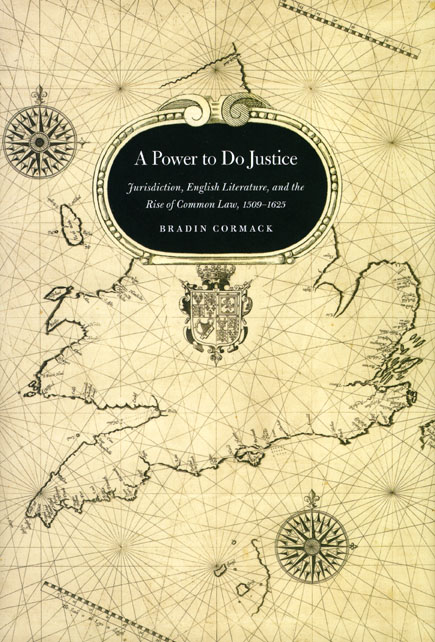
English law underwent rapid transformation in the sixteenth century, in response to the Reformation and also to heightened litigation and legal professionalization. As the common law became more comprehensive and systematic, the principle of jurisdiction came under particular strain. When the common law engaged with other court systems in England, when it encountered territories like Ireland and France, or when it confronted the ocean as a juridical space, the law revealed its qualities of ingenuity and improvisation. In other words, as Bradin Cormack argues, jurisdictional crisis made visible the law’s resemblance to the literary arts.
A Power to Do Justice shows how Renaissance writers engaged the practical and conceptual dynamics of jurisdiction, both as a subject for critical investigation and as a frame for articulating literature’s sense of itself. Reassessing the relation between English literature and law from More to Shakespeare, Cormack argues that where literary texts attend to jurisdiction, they dramatize how boundaries and limits are the very precondition of law’s power, even as they clarify the forms of intensification that make literary space a reality.
Tracking cultural responses to Renaissance jurisdictional thinking and legal centralization, A Power to Do Justice makes theoretical, literary-historical, and methodological contributions that set a new standard for law and the humanities and for the cultural history of early modern law and literature.
A Power to Do Justice shows how Renaissance writers engaged the practical and conceptual dynamics of jurisdiction, both as a subject for critical investigation and as a frame for articulating literature’s sense of itself. Reassessing the relation between English literature and law from More to Shakespeare, Cormack argues that where literary texts attend to jurisdiction, they dramatize how boundaries and limits are the very precondition of law’s power, even as they clarify the forms of intensification that make literary space a reality.
Tracking cultural responses to Renaissance jurisdictional thinking and legal centralization, A Power to Do Justice makes theoretical, literary-historical, and methodological contributions that set a new standard for law and the humanities and for the cultural history of early modern law and literature.
424 pages | 21 halftones | 6 x 9 | © 2008
History: European History
Law and Legal Studies: Legal History
Literature and Literary Criticism: British and Irish Literature
Reviews

Table of Contents
List of Illustrations
Acknowledgments
Note on Citations
Prologue: A Power to Do Justice
Introduction: Literature and Jurisdiction
Part I Centralization
1 “Shewe Us Your Mynde Then”: Bureaucracy and Royal Privilege in Skelton’s Magnyfycence
2 “No More to Medle of the Matter”: Thomas More, Equity, and the Claims of Jurisdiction
Part II Rationalization
3 Inconveniencing the Irish: Custom, Allegory, and the Common Law in
Spenser’s Ireland
4 “If We Be Conquered”: Legal Nationalism and the France of
Shakespeare’s English Histories
Part III Formalization
5 “To Stride a Limit”: Imperium, Crisis, and Accommodation in
Shakespeare’s Cymbeline and Pericles
6 “To Law for Our Children”: Norm and Jurisdiction in Webster, Rowley,
and Heywood’s Cure for a Cuckold
Notes
Index
Acknowledgments
Note on Citations
Prologue: A Power to Do Justice
Introduction: Literature and Jurisdiction
Part I Centralization
1 “Shewe Us Your Mynde Then”: Bureaucracy and Royal Privilege in Skelton’s Magnyfycence
2 “No More to Medle of the Matter”: Thomas More, Equity, and the Claims of Jurisdiction
Part II Rationalization
3 Inconveniencing the Irish: Custom, Allegory, and the Common Law in
Spenser’s Ireland
4 “If We Be Conquered”: Legal Nationalism and the France of
Shakespeare’s English Histories
Part III Formalization
5 “To Stride a Limit”: Imperium, Crisis, and Accommodation in
Shakespeare’s Cymbeline and Pericles
6 “To Law for Our Children”: Norm and Jurisdiction in Webster, Rowley,
and Heywood’s Cure for a Cuckold
Notes
Index
Awards
Sixteenth Century Studies Conference: Roland H. Bainton Book Prize
Honorable Mention