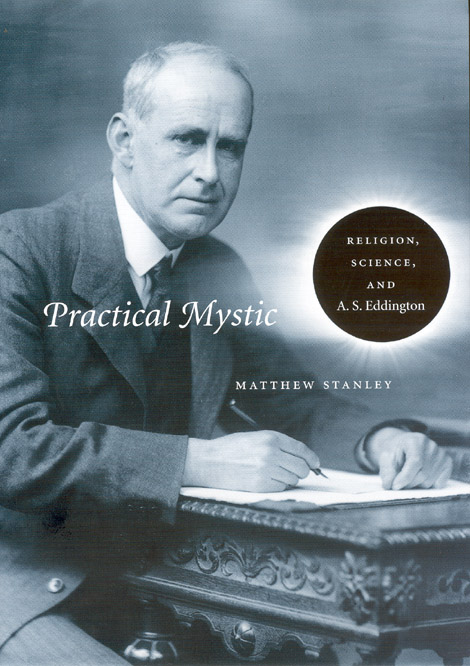
Practical Mystic

Religion, Science, and A. S. Eddington

Matthew Stanley

 Practical Mystic
Bookmark and Share

Matthew Stanley

320 pages | 16 halftones, 2 line drawings | 6 x 9 | © 2007
Cloth $40.00 ISBN: 9780226770970 Published November 2007
Science and religion have long been thought incompatible. But nowhere has this apparent contradiction been more fully resolved than in the figure of A. S. Eddington (1882–1944), a pioneer in astrophysics, relativity, and the popularization of science, and a devout Quaker. Practical Mystic uses the figure of Eddington to shows how religious and scientific values can interact and overlap without compromising the integrity of either.

Eddington was a world-class scientist who not only maintained his religious belief throughout his scientific career but also defended the interrelation of science and religion while drawing inspiration from both for his practices. For instance, at a time when a strict adherence to deductive principles of physics had proved fruitless for understanding the nature of stars, insights from Quaker mysticism led Eddington to argue that an outlook less concerned with certainty and more concerned with further exploration was necessary to overcome the obstacles of incomplete and uncertain knowledge.

By examining this intersection between liberal religion and astrophysics, Practical Mystic questions many common assumptions about the relationship between science and spirituality. Matthew Stanley’s analysis of Eddington’s personal convictions also reveals much about the practice, production, and dissemination of scientific knowledge at the beginning of the twentieth century.

History of Science Society: Pfizer Award
Short Listed/Finalist

View Recent Awards page for more award winning books.
“Matthew Stanley’s book provides important new insights on Eddington’s life and beliefs.  He convincingly shows how Eddington’s science was shaped by his religious values, providing a striking illustration of the need for us to transcend the old idea that science and religion are at war.”—Peter J. Bowler, Queen’s University of Belfast


“Arthur Eddington, a Cumbrian-born Quaker, peace campaigner, public lecturer and heroic bicyclist, was also one of the twentieth century's greatest scientists. His writings on relativity theory and the evolution of stars decisively affected the growth of physical science in the decades between the two World Wars. He helped make Einstein’s science meaningful and established the basis of a new astrophysics. In this clever and careful book, Matthew Stanley uses Eddington's remarkable scientific and religious career to illuminate and challenge the ways we think about the relation between the aims of physical science and religious belief. This is not a story of the simple-minded conflict of scriptural literalism and scientific ambition. Instead, using a wealth of startling and intelligently interpreted records of the life of this fascinating intellectual and political activist, Stanley indicates how in this telling case the realms of spiritual value and of the quest for scientific understanding could so productively interact. The book will be a vital source for historical interpretations of astronomy and religion and in current debates on the fraught relations between belief and truth.”—Simon Schaffer, University of Cambridge


“At a time when many voices loudly proclaim the incompatibility of science and religion, this luminous biography of the Cambridge astrophysicist Arthur Stanley Eddington reminds us that real life rarely conforms to simplistic generalizations. Matthew Stanley demonstrates not only the compatibility of science and religion in the life of this devout Quaker but the existence of a positive symbiosis. Few biographers have shown the interconnections so clearly and convincingly.”—Ronald Numbers, coeditor of When Science and Christianity Meet


“Best known as a pioneer astrophysicist and successful expositor of popular physics and philosophy, Eddington was also deeply immersed in philosophy and convinced that his science was complementary to his religious faith. In Practical Mystic, Matthew Stanley presents a detailed and synthetic study of the great scientist, demonstrating convincingly the coherence of his scientific, intellectual, and religious values. This is a scholarly work of the first class, an innovative and very readable contribution to the history of modern science, philosophy, and religion. Although dealing with the first half of the twentieth century, the relevance of Stanley's rich biography is not limited to the past.”—Helge Kragh, University of Aarhus, Denmark


“Scholarship in the history of modern astrophysics is substantially enhanced with the publication of Matt Stanley’s Practical Mystic: Religion, Science and A. S. Eddington.  Much has been written on Eddington, the principal astrophysical theorist of the first half of the twentieth century, but until now Eddington and his style of doing and communicating science have remained shadowy and distant. Stanley’s eloquent and sophisticated study has created, at last, a three-dimensional portrait of Eddington while at the same time dispelling many of the myths that have lingered about the man and his relationship to, and regard for, his fellow scientists, his life, and his universe.”—David H. DeVorkin, Senior Curator, Astronomy, Department of Space History, National Air and Space Museum, Smithsonian Institution


"In this extraordinary book about the life of the distinguished English astrophysicist Sir Arthur Eddington, Matthew Stanley examines the entangled roles of science and religion in his work. . . . Practical Mystic is not a biography but a biographical study—a fascinating one."—Owen Gingerich, Nature


"In this fascinating study of Eddington and his worldviews, author Stanley offers glimpses of the conflicts between science and the religious spirit more than six decades ago. He also gives the reader insights into Eddington's astrophysics and the gist of some of his more popular books. This very interesting and well-researched work is enormously relevant in the context of current confrontations. Though very little seems to have changed in the debates, in actuality, there are no scientists of Eddington's stature today who dare to speak about their religious convictions as openly as Eddington did without risking their professional reputation."—Choice


"Most of the extensive scholarship about the history of science and religion focuses on the interaction of scientific facts and theories with religious beliefs. Matthew Stanley's splendid biography of Arthur Eddington, one of the greatest cosmologists of the twentieth century, is an outstanding exception. . . . Stanley writes with some eloquence about what he calls 'valence values' that link religion to science, largely independently of specific theological doctrines and scientific conclusions. . . . Readers convinced of the value of values will likely find this book invaluable."—Edward B. Davis, Journal for the History of Astronomy


"A fascinating study of Eddington's life and attitudes, and it sheds light on how science and religion can exist in harmony."—Physics World


"Historians of physics and astronomy will welcome Stanley’s survey of British responses to relativity....The central thesis of the book is persuasively argued: the fact that ontological claims drawn from theology no longer informed the content of physical theory emphatically does not mean that religious values ceased to have relevance to a life in science. For Eddington, scientific creativity itself bore witness to that divine spark in the human mind that pointed to the presence of a greater Mind."—John Hedley Brooke, British Journal for the History of Science


"Anyone who has ever read a book on the relationship of science and religion will appreciate the novelty and detail in this reading of the scientific and religious life of Sir Arthur Eddington. . . . By all means, read this fascinating, finely-crafted book."


"I strongly recomend Stanley's book; he has explored the connection between Eddington's religion and science more deeply than any previous writer . . . and his book is essential reading for anyone who wishes to understand the motivations, in both life and science, of its subject. It is also a major contribution to the wider debate about the relationship of science and religion."


Contents
Acknowledgments 
Introduction 
 
1. The Quaker Renaissance: Making a Religious Scientist 
2. Mysticism: Seeking and Stellar Models 
3. Internationalism: The 1919 Eclipse and Eddington as Quaker Adventurer 
4. Pacifism: Confronting the State and Maintaining Identity in War 
5. Experience: From Relativity to Religion 
6. Religion in Modern Life: Science, Philosophy, and Liberal Theology in Interwar Britain 
7. Thinking about Values and Science 
 
Notes  
Bibliographic Note 
Bibliography 
Index  
For more information, or to order this book, please visit http://www.press.uchicago.edu
Google preview here

Chicago Manual of Style |

Chicago Blog: Religion

Events in Religion

Keep Informed

JOURNALs