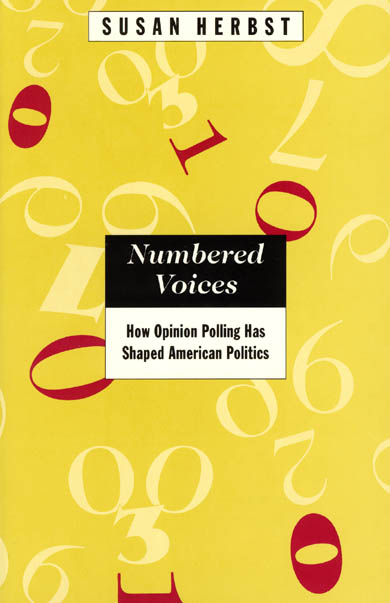
Numbered Voices
How Opinion Polling Has Shaped American Politics
9780226327433
9780226327426
Numbered Voices
How Opinion Polling Has Shaped American Politics
Quantifying the American mood through opinion polls appears to be an unbiased means for finding out what people want. But in Numbered Voices, Susan Herbst demonstrates that the way public opinion is measured affects the use that voters, legislators, and journalists make of it.
Exploring the history of public opinion in the United States from the mid-nineteenth century to the present day, Herbst shows how numbers served both instrumental and symbolic functions, not only conveying neutral information but creating a basis authority. Addressing how the quantification of public opinion has affected contemporary politics and the democratic process, Herbst asks difficult but fundamental questions about the workings of American politics.
"An original and thought-provoking analysis of why we have polls, what they accomplish, and how they affect the current political scene. Herbst’s scholarship is impeccable, her writing is clear and crisp, and her findings are original. . . . Every reader will benefit by carefully weighing the issues she raises and the conclusions she draws."—Doris A. Graber, Political Science Quarterly
"An intelligent, theoretically rich, and historically broad account of public opinion over several millennia. . . . The historical accounts are interesting and her interpretations are thought-provoking."—Paul Brace, Journal of American History
Exploring the history of public opinion in the United States from the mid-nineteenth century to the present day, Herbst shows how numbers served both instrumental and symbolic functions, not only conveying neutral information but creating a basis authority. Addressing how the quantification of public opinion has affected contemporary politics and the democratic process, Herbst asks difficult but fundamental questions about the workings of American politics.
"An original and thought-provoking analysis of why we have polls, what they accomplish, and how they affect the current political scene. Herbst’s scholarship is impeccable, her writing is clear and crisp, and her findings are original. . . . Every reader will benefit by carefully weighing the issues she raises and the conclusions she draws."—Doris A. Graber, Political Science Quarterly
"An intelligent, theoretically rich, and historically broad account of public opinion over several millennia. . . . The historical accounts are interesting and her interpretations are thought-provoking."—Paul Brace, Journal of American History
235 pages | 7 halftones and line drawings, 6 tables | 5-1/2 x 8-1/2 | © 1993
American Politics and Political Economy Series
Political Science: American Government and Politics, Political Behavior and Public Opinion

Table of Contents
Preface
Introduction
1: Quantification and Rationality
2: Numbers and Symbolic Politics
3: Techniques of Opinion Expression and Measurement
4: Partisan Politics and the Symbolic Use of Straw Polls, 1856-1936
5: Congressmen, Journalists, and Opinion Assessment, 1930-1950
6: Contemporary Public Opinion Research
7: Crowd Estimation and Public Opinion
8: Opinion Quantification and Democracy
Notes
Bibliography
Index
Introduction
1: Quantification and Rationality
2: Numbers and Symbolic Politics
3: Techniques of Opinion Expression and Measurement
4: Partisan Politics and the Symbolic Use of Straw Polls, 1856-1936
5: Congressmen, Journalists, and Opinion Assessment, 1930-1950
6: Contemporary Public Opinion Research
7: Crowd Estimation and Public Opinion
8: Opinion Quantification and Democracy
Notes
Bibliography
Index